Hormonal contraceptives are frequently offered to people with endometriosis — sometimes before a formal diagnosis has even been confirmed. Understanding what they actually do, why they help, and what their limits are helps you have a more informed conversation with your doctor about whether they are the right option for you.
Hormonal treatments are a frontline strategy for managing endometriosis symptoms. They work by suppressing the oestrogen-driven activity of lesions — reducing menstrual pain, pelvic pain, and cyclical flares in most people who use them. They do not remove lesions, reverse scarring, or cure endometriosis; symptoms often return when treatment stops. The right hormonal option depends on your individual circumstances, tolerability, and reproductive plans, and the choice should always be made with a gynaecologist.
Key Takeaways
- Hormonal treatments manage endometriosis symptoms by suppressing the oestrogen signalling that drives lesion activity — they are not a cure and do not remove lesions
- The combined pill used continuously (skipping the pill-free week) is the standard approach; the pill-free week triggers a withdrawal bleed that can worsen endo symptoms
- Progestogen-only options — the progestogen-only pill, the hormonal IUD (Mirena), the implant, and the injectable — are effective alternatives for people who cannot take oestrogen
- GnRH agonists and antagonists are a more potent second-line class that creates a temporary medical menopause; they are used under specialist supervision
- Fertility is not permanently affected — ovulation and menstrual cycles return after stopping most hormonal treatments, though timing varies by method
- Tracking symptoms before and after starting treatment gives you and your doctor objective evidence of whether the treatment is working
How Hormonal Treatment Works in Endometriosis
Endometriosis is an oestrogen-dependent condition. Lesions — tissue similar to the endometrium that has implanted outside the uterus — respond to the monthly rise and fall of oestrogen and progesterone in the same way the uterine lining does. Each cycle, they become active, produce inflammatory cytokines, swell, and bleed into surrounding tissue. This cycle of monthly activation drives pain, adhesion formation, and progressive local damage.
Hormonal treatments interrupt this cycle in two main ways:
- Suppressing ovulation and menstruation — reducing or eliminating the monthly hormonal fluctuations that activate lesions
- Opposing oestrogen directly — creating a progestogen-dominant hormonal environment that promotes atrophy (shrinkage) of lesion tissue
The result, in most people, is a significant reduction in the inflammatory activity that produces pain and other symptoms. This doesn’t mean the lesions disappear — they don’t — but their monthly triggering is dampened or eliminated.
If you are still waiting for a formal diagnosis, see our guide to how to get an endometriosis diagnosis for how to navigate referral pathways.
The Combined Pill — and Why Continuous Use Matters
The combined oral contraceptive pill (containing both oestrogen and progestogen) is typically the first hormonal treatment offered for endometriosis, recommended in guidelines from NICE (UK), ESHRE (Europe), and ACOG (US).
It works by suppressing ovulation and maintaining a low, stable hormonal environment rather than the cyclical highs and lows of an unmedicated cycle. This significantly reduces the monthly activation of lesion tissue.
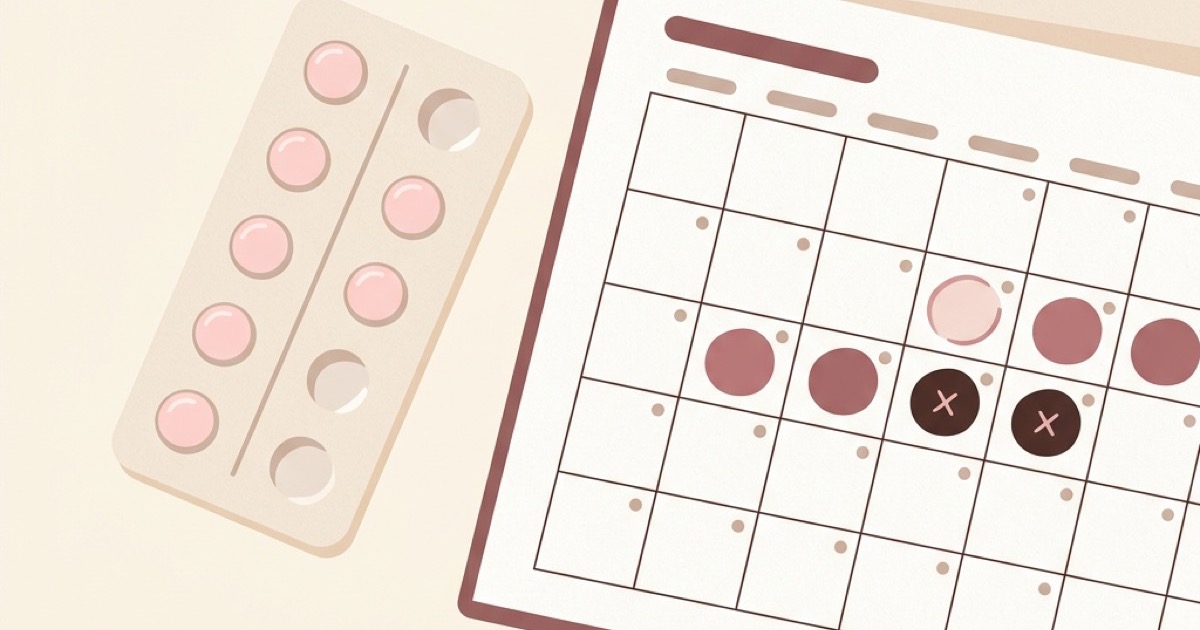
The critical point is how it is taken. The standard 21-days-on / 7-days-off schedule includes a pill-free week specifically designed to produce a withdrawal bleed — a bleed that is functionally similar to a period. For someone with endometriosis, this monthly trigger is exactly what hormonal treatment is trying to avoid.
Continuous use — taking active pills without a break, skipping the pill-free week or the placebo pills in a 28-day pack — suppresses this withdrawal bleed entirely. NICE guideline NG73 and the ESHRE endometriosis guideline both endorse continuous combined pill use for endometriosis management. Most people need 3–6 months of continuous use before the full pain benefit becomes apparent, and some breakthrough bleeding is common in the first few months while the endometrium stabilises.
The combined pill is not suitable for everyone. People with migraine with aura, a personal or family history of blood clots (VTE), certain cardiovascular risk factors, or certain liver conditions are typically advised against oestrogen-containing contraceptives. In these cases, progestogen-only options are appropriate.
Progestogen-Only Options
Progestogens (synthetic progesterone-like hormones) suppress endometriosis by opposing oestrogen signalling and promoting atrophy of lesion tissue. They are effective in their own right — not simply a back-up for people who can’t take the combined pill — and for some people they provide better symptom control.
Progestogen-Only Pill (Mini-pill)
The progestogen-only pill is taken daily without a break. Its primary mechanism at standard doses is thickening cervical mucus rather than suppressing ovulation (though some preparations at higher doses do suppress ovulation). For endometriosis, dedicated progestogen-only preparations rather than standard low-dose mini-pills are often preferred, and choices vary by country. Discuss with your gynaecologist which formulation is appropriate.
The Hormonal IUD (Mirena / Levonorgestrel IUD)
The levonorgestrel IUD (most commonly the Mirena) delivers progestogen directly into the uterine cavity. Its local action suppresses the endometrium and reduces menstrual bleeding, which can significantly reduce menstrual pain and period-related endo flares. Because the hormone is delivered locally rather than systemically, many people experience fewer systemic progestogen side effects (such as mood changes or weight fluctuation), though these can still occur.
The Mirena has strong evidence for reducing endometriosis-related dysmenorrhoea and is particularly effective when there is an adenomyosis component to symptoms. It does not reliably suppress ovulation at standard doses, which means it is less effective at suppressing activity of endometriosis lesions located outside the uterus. It lasts up to 5–8 years depending on licensed use, and fertility returns promptly after removal.
The Implant (Nexplanon)
The subdermal progestogen implant (Nexplanon or equivalent) releases a progestogen continuously and suppresses ovulation reliably. In some people, it leads to amenorrhoea (no periods), which reduces endo symptom burden substantially. In others, it causes irregular or prolonged bleeding, particularly in the first year — a common reason for discontinuation. The implant lasts three years. Its use for endometriosis is supported by clinical guidelines as an effective progestogen-delivery method, though it is less extensively studied specifically for endo than the combined pill or IUD.
The Injectable (Depo-Provera)
Intramuscular or subcutaneous medroxyprogesterone acetate (Depo-Provera) is a progestogen injection given every 12–13 weeks. It reliably suppresses ovulation and, in many users, produces amenorrhoea — which can substantially reduce endometriosis symptoms. It is highly effective for pain control.
The main considerations with the injectable are:
- Irregular bleeding is common, particularly in the first 6–12 months
- Return of fertility after stopping is delayed compared to other methods — cycles can take several months to a year or more to resume, which matters for people with fertility considerations (see our article on endometriosis and fertility)
- Bone density: prolonged use is associated with reduced bone mineral density, which is reversible after stopping but is a consideration for long-term use, particularly in younger patients
GnRH Agonists and Antagonists — The Specialist Second-Line Class
GnRH (gonadotrophin-releasing hormone) agonists (such as goserelin, nafarelin, leuprorelin/Lupron) and GnRH antagonists (such as elagolix/Orilissa, relugolix) are a distinct and more potent class of hormonal suppression, distinct from contraceptives. They work by suppressing the pituitary-ovarian axis, reducing ovarian oestrogen production to near-menopausal levels — a state sometimes called medical menopause.
This is the most complete hormonal suppression available and produces significant pain relief in most people with endometriosis. However, the menopausal side effects — hot flushes, night sweats, vaginal dryness, sleep disruption — and with longer-term agonist use (typically beyond six months), bone density reduction, mean they are used under specialist supervision rather than as a first-line option.
Add-back therapy — co-prescribing low-dose oestrogen and/or progestogen alongside GnRH treatment — manages most of the side effects while preserving the majority of the pain benefit.
GnRH agents are typically used:
- When first-line hormonal options have not provided adequate control
- As pre- or post-surgical adjuncts
- For more severe disease under specialist gynaecological management
The newer GnRH antagonists have the advantage of oral dosing (agonists are injected or nasal spray) and more rapid onset and offset, offering more flexibility in use.
For a closer look at the two most commonly prescribed GnRH options in the US — including what to expect in the first weeks, side effects, and how to track whether one is working — see Lupron and Orilissa for endometriosis: what to expect.
What Hormonal Treatment Does NOT Do
It is important to be clear-eyed about the limits of hormonal management for endometriosis:
- It does not remove lesions. Existing lesions, adhesions, and scar tissue remain after starting hormonal treatment. Symptoms are managed by suppressing lesion activity, not by removing the cause.
- It is not a cure. When treatment stops, the hormonal environment that drives lesion activity returns, and symptoms typically return over time. For many people, long-term or indefinite treatment is the strategy.
- It does not reliably suppress all disease. Some lesions — particularly deep infiltrating endometriosis or endometriomas — may continue to cause symptoms even under hormonal treatment. Surgical assessment may still be required.
- It cannot be used during attempts to conceive. Hormonal suppression prevents pregnancy. For people who are trying to conceive, the approach to symptom management changes significantly — see our article on endometriosis and fertility for what that pathway looks like.
- Symptoms may return after surgery too, and hormonal treatment post-operatively is often recommended to reduce recurrence risk. See our guide to endometriosis surgery recovery for post-surgical management considerations.
Side Effects and Choosing the Right Option
All hormonal treatments carry potential side effects, and individual response varies considerably. Common considerations include:
Combined pill: Nausea (usually temporary), breast tenderness, mood changes, headache. Small increased risk of blood clots (VTE) with oestrogen-containing preparations — the absolute risk is low but relevant for those with additional risk factors.
Progestogens (all types): Irregular or unpredictable bleeding (particularly in the first months), mood changes, acne, bloating, reduced libido. These vary significantly between different progestogens — someone who responds poorly to one may do well on another.
Hormonal IUD: Insertion discomfort (which can be significant; discuss pain management options with your provider), irregular spotting for the first 3–6 months, rare risk of expulsion or perforation.
Implant: Irregular bleeding is the most common reason for early removal.
Injectable: Irregular bleeding early on; delayed return of fertility; long-term bone density considerations.
GnRH agents: Menopausal symptoms; bone density (add-back therapy mitigates this); mood effects; high cost without add-back.
No single option is right for everyone. Choosing a hormonal treatment for endometriosis involves weighing your symptom pattern, oestrogen tolerance, reproductive plans, how you’ve responded to previous treatments, and your preferences about delivery method (pill vs. device vs. injection). This decision belongs in a conversation with a gynaecologist with experience in endometriosis — not as a default prescription, but as an individualised clinical choice.
Endometriosis pain management often involves combining hormonal treatment with non-hormonal strategies (NSAIDs, pelvic floor physiotherapy, pain psychology), particularly for people with moderate to severe or treatment-resistant pain. Hormonal treatment works best within a broader management plan rather than in isolation.
Tracking Your Response to Hormonal Treatment
One of the most common frustrations in endometriosis care is not knowing whether a new treatment is actually working — particularly when change is gradual, when some symptoms improve while others don’t, or when you are several months into a treatment and trying to remember what your pain was like before.
EndoTracking lets you log daily pain scores, pain location, symptom type, cycle phase, and medication use — creating a before/after record that makes treatment response visible rather than impressionistic. When switching to a new hormonal method or adjusting dose, having a logged baseline for the three months prior (and tracking the three months after) gives you and your gynaecologist objective evidence about whether the treatment is working, partially working, or not working for you.
This is also useful when changing from one progestogen to another, or from the pill to an IUD — transitions where the adjustment period can make it hard to judge long-term benefit from short-term side effects.
See our guide to using a endometriosis symptom tracker for how to structure your tracking to get the most useful clinical data.
EndoTracking is a personal health tracking app and does not provide medical advice. All decisions about hormonal treatment for endometriosis should be made in discussion with a qualified gynaecologist or healthcare provider.