When someone is first diagnosed with endometriosis, one of the first questions is usually about stage. Stage IV sounds ominous. Stage I sounds manageable. But the relationship between what a stage number actually means and what it will mean for your daily life is more complicated — and more counterintuitive — than most people expect.
Endometriosis is classified into four stages (I to IV) based on the location, extent, and depth of lesions found at laparoscopy. But staging is a surgical scoring tool, not a guide to pain severity or quality of life. Some people with Stage IV have minimal symptoms; others with Stage I are severely disabled. Understanding what the stage does and doesn’t tell you is essential for setting realistic expectations.
Key Takeaways
- The four-stage classification system (ASRM) is based on a numerical score from laparoscopic findings — it reflects surgical complexity, not symptom burden
- Stage is a poor predictor of pain: pain correlates more strongly with nerve involvement and lesion location than with stage
- Stage predicts fertility outcome better than pain, but still imperfectly — many Stage IV patients conceive naturally
- Progression through stages is possible but not inevitable; hormonal suppression is the primary way to slow it
- The ASRM system is widely acknowledged as imperfect; the rAFS scoring has known limitations, and newer classification systems (including the #Enzian system for deep infiltrating endo) are increasingly used in specialist centres
The Four Stages: What the Score Measures
The current staging system was revised by the American Fertility Society in 1996 and is known as the revised American Fertility Society (rAFS) classification. It assigns numerical points based on:
- The number, size, and depth of peritoneal and ovarian lesions
- Whether lesions are superficial or deep
- The presence, extent, and density of adhesions (scar tissue binding organs together)
- Whether adhesions affect the fallopian tubes and ovaries
The total score determines the stage:
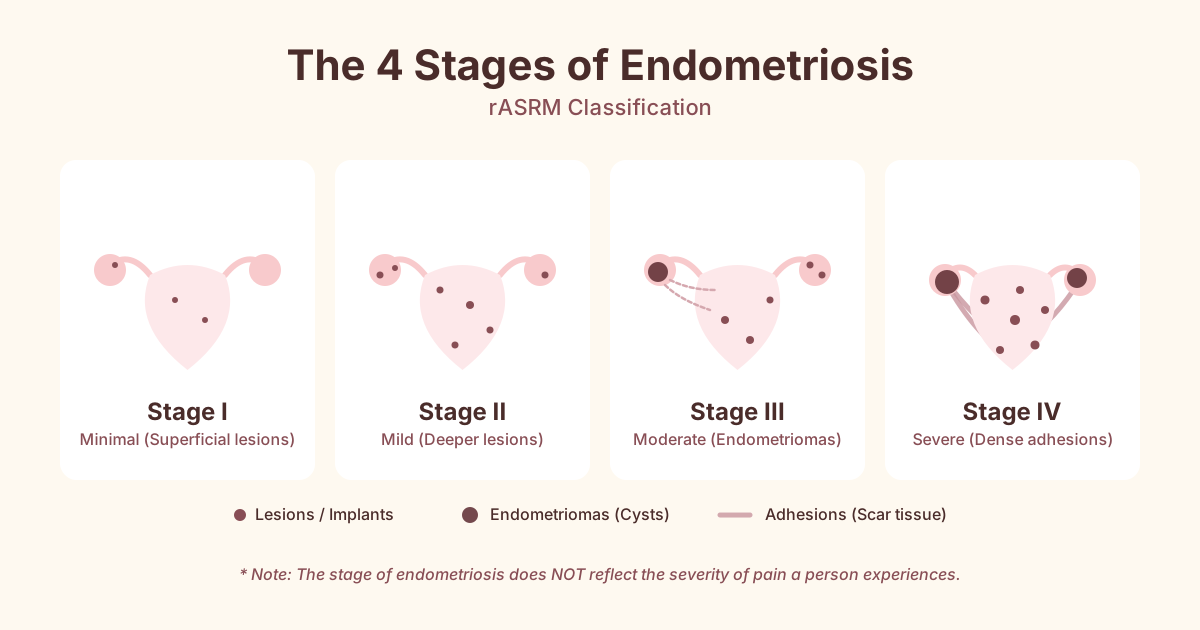
- Stage I (Minimal): 1–5 points. Isolated, superficial peritoneal implants with no clinically significant adhesions. The pelvis is otherwise anatomically normal.
- Stage II (Mild): 6–15 points. More implants, including some deeper lesions, and possibly small adhesions. Tubes and ovaries remain largely functional.
- Stage III (Moderate): 16–40 points. Multiple deep infiltrating implants, at least one endometrioma (ovarian cyst), and adhesions involving the tube(s) or ovary/ovaries. Pelvic anatomy beginning to be distorted.
- Stage IV (Severe): >40 points. Widespread deep infiltrating disease, large endometriomas (typically over 2cm), and dense adhesions causing significant distortion of pelvic anatomy. May involve the bowel, bladder, ureter, or other structures.
What the Stage Does Not Tell You
It Does Not Tell You How Much Pain You Have
This is the most important limitation of the staging system. Pain in endometriosis is determined primarily by:
- Lesion location, not size or quantity — a small lesion on a nerve has far more pain impact than a large lesion in a less innervated area
- Nerve involvement — deep infiltrating lesions that compress or infiltrate pelvic nerves cause severe neurological pain regardless of stage
- Central sensitisation — the state of the nervous system after prolonged pain exposure amplifies pain signals beyond what the current lesion burden would predict
The clinical literature is consistent on this: ASRM stage correlates very poorly with pain severity. There are well-documented cases of Stage IV patients who are relatively asymptomatic and Stage I patients whose pain is debilitating.
“ASRM stage was never designed to measure pain — it was designed as a surgical planning tool. Expecting stage to predict how much you’ll suffer is like expecting a building’s floor area to predict how noisy it is.”
This matters practically: if you have severe symptoms but a low stage at laparoscopy, that result does not mean your pain is exaggerated or irrational. It means the staging system didn’t capture what was causing your pain.
It Does Not Tell You Whether You’ll Progress
Endometriosis is progressive in many people but not all. Without hormonal suppression, disease tends to grow and spread over time — particularly in the reproductive years when estrogen levels are sustained. But some people remain at Stage I for many years. There is no reliable way to predict, from the stage at first diagnosis, whether an individual’s disease will progress rapidly or slowly.
Monitoring over time — ideally with specialist imaging at defined intervals and systematic symptom tracking — is more informative than a single staging assessment.
It May Underestimate Bowel and Deep Infiltrating Disease
The ASRM system was developed primarily with ovarian and peritoneal disease in mind. It is less well-suited to staging deep infiltrating endometriosis (DIE) — which includes bowel, bladder, and ureteric involvement — where the #Enzian classification is increasingly preferred by specialist centres. If you have symptoms suggesting bowel or bladder involvement (cyclical rectal bleeding, dyschezia, urinary symptoms), the ASRM stage from a standard laparoscopy may significantly underestimate the true disease burden.
What Stage Does Predict (Somewhat) — Fertility
Stage is a more useful guide for fertility than for pain. There is a general correlation between higher stage and reduced fertility, because the adhesions, endometriomas, and tubal distortion in Stage III–IV disease create structural barriers to conception.
- Stage I–II: fertility impact is real but mainly via inflammatory peritoneal mechanisms; monthly conception probability is reduced (approx 2–10% per cycle vs 15–20% baseline) but structural anatomy is largely normal
- Stage III–IV: more direct structural impact — adhesions may block tubes, endometriomas reduce ovarian reserve, and widespread disease may distort the entire reproductive anatomy
But even here, stage is imperfect. Some Stage IV patients conceive naturally. Many Stage I patients require assisted reproduction. Individual factors — ovarian reserve, partner fertility, surgical history — matter as much as stage. See our guide to endometriosis and fertility for a more detailed analysis.
Can You Go Backward in Stage?
Stage is measured at a single surgical moment. After excision surgery, lesions are removed — and if you were re-staged at surgery, you would theoretically be lower stage. But this doesn’t mean the disease is cured: residual microscopic disease, or disease that grows back from new lesion formation, can return to a higher stage over time.
Hormonal suppression post-surgery reduces the rate of new lesion formation by suppressing the estrogen-driven environment in which endo grows. This is why post-surgical hormonal management is a key conversation to have with your surgeon. See our recovery guide for more on post-surgical management.
How Stage Affects Treatment Decisions
While stage shouldn’t determine how seriously your pain is taken, it does legitimately inform some treatment decisions:
Stage I–II: First-line hormonal management (combined pill, progestins, LNG-IUD) is usually appropriate before surgery is considered. Surgery may be offered if hormonal management fails or if fertility is the primary concern. Specialist excision is not usually required unless symptoms are severe or unusual.
Stage III–IV: Specialist referral is generally indicated. Surgery at a dedicated endometriosis centre (rather than a general gynaecology unit) significantly improves outcomes — including recurrence rates — for complex disease. Fertility planning should be discussed at diagnosis, since ovarian reserve may be at risk from endometrioma progression or surgery. Multidisciplinary input (colorectal surgery, urology) may be needed for bowel or bladder involvement.
Tracking Beyond Stage
Because stage is a snapshot from a single laparoscopy — and because it correlates poorly with how you feel day to day — the more practically useful measure of your disease over time is your symptom burden: how your pain, fatigue, gut symptoms, and cycle patterns change month to month.
Systematic tracking across cycles creates a longitudinal record that stage cannot provide. It tells you whether your symptoms are worsening (which might signal progression), responding to treatment, or stable. EndoTracking is designed specifically for this — logging symptoms daily, mapping them to cycle phase, and generating reports that give your specialist a clear picture of how your disease behaves in real life, not just at surgery.
For guidance on what to track and how to use the data at your next appointment, see how to prepare for your endo appointment.
EndoTracking is a personal health tracking app and does not provide medical or surgical advice. Staging of endometriosis can only be determined by a qualified surgeon at laparoscopy.