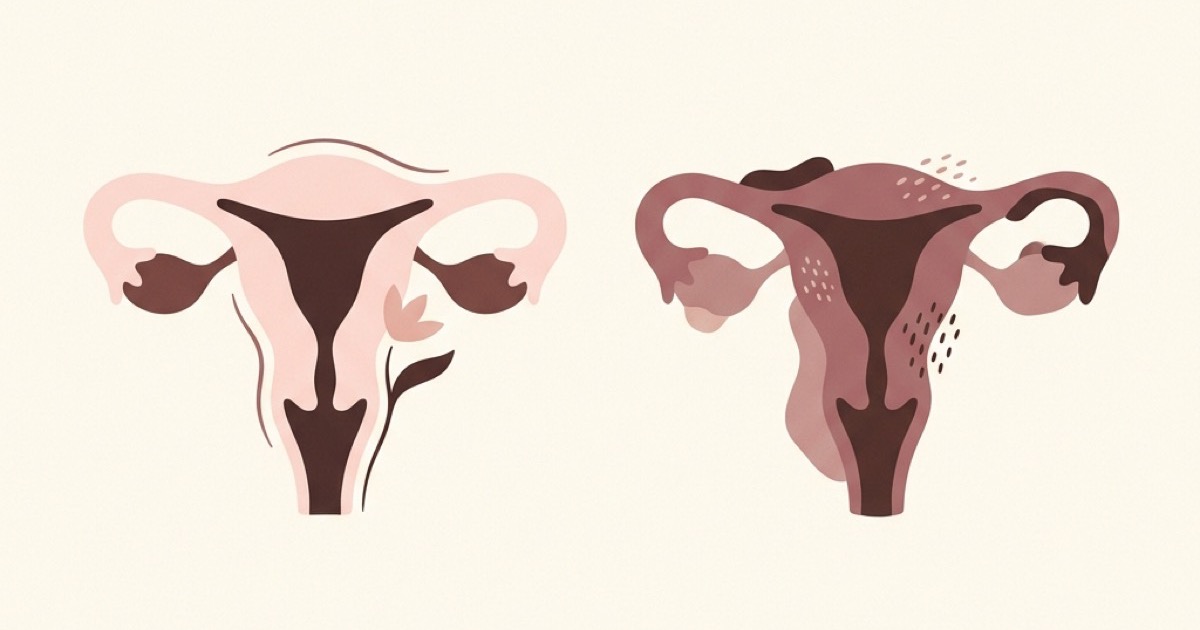
Endometriosis and uterine fibroids are among the most common gynaecological conditions in women of reproductive age, and their names sometimes get conflated in the same conversation about pelvic health. They are not the same. They have different underlying biology, different dominant symptoms, and very different diagnostic pathways — and mistaking one for the other, or assuming a fibroid diagnosis explains all your symptoms, can leave significant disease untreated.
The overlap that causes confusion is real: both conditions are influenced by oestrogen, both can affect fertility, and both can cause some degree of pelvic pain or discomfort. But the conditions diverge sharply in what they do and how they feel — and understanding where they differ is the first step to getting the right investigation. For related comparisons, see adenomyosis vs endometriosis and PCOS vs endometriosis.
Endometriosis is an inflammatory disease in which tissue resembling the uterine lining grows outside the uterus, causing lesions, adhesions, and progressive pelvic damage. Uterine fibroids (leiomyomas) are benign muscular tumours that grow within or on the uterine wall itself. The clearest clinical distinction is symptom character: endometriosis is defined by pain — particularly severe, progressive dysmenorrhoea and dyspareunia — while fibroids are most often defined by heavy menstrual bleeding and bulk pressure symptoms. Fibroids are reliably visible on standard ultrasound; endometriosis usually is not. Crucially, you can have both.
Key Takeaways
- Endometriosis is an inflammatory, structural disease causing tissue to grow outside the uterus; fibroids are benign muscular tumours within the uterine wall — different categories of disease entirely
- The dominant symptom of endometriosis is pelvic pain (dysmenorrhoea, dyspareunia, chronic pelvic pain); the dominant symptom of fibroids is heavy menstrual bleeding and bulk pressure
- Fibroids are reliably visible on standard pelvic ultrasound; endometriosis is frequently invisible on standard imaging and may require specialist ultrasound, MRI, or laparoscopy to confirm
- Both conditions are influenced by oestrogen and are common in reproductive-age women, but they have different underlying biology and different treatments
- Both conditions can impair fertility, through different mechanisms — fibroids through uterine distortion; endometriosis through inflammation, adhesions, and tubal damage
- The two conditions can coexist, and a fibroid diagnosis alone does not explain severe cyclical pain or deep dyspareunia
Two Different Kinds of Condition
The most important starting point is understanding that endometriosis and fibroids are fundamentally different types of disease — not variations on a theme.
Endometriosis is an inflammatory, systemic disease. Tissue similar to the endometrium — the lining shed during menstruation — grows in locations outside the uterus: on the ovaries, the peritoneum, the uterosacral ligaments, the bowel, and sometimes further afield. This ectopic tissue responds to the hormonal cycle, bleeds, and provokes an intense chronic inflammatory response. The result is scar tissue, adhesions that bind organs together, and progressive damage. Endometriosis affects roughly 1 in 10 women of reproductive age. For a full overview, see what is endometriosis.
Uterine fibroids (also called leiomyomas or myomas) are benign smooth muscle tumours that develop within or on the wall of the uterus itself. They are not cancerous and do not spread. Fibroids are extremely common — the majority of women will develop at least one fibroid during their lifetime, though many never cause symptoms. Their growth is oestrogen-dependent, which is why they tend to shrink after the menopause. They cause problems primarily through mechanical means: heavy bleeding, pressure on surrounding structures, and, depending on location, interference with the uterine cavity.
“Endometriosis is a disease of tissue growing where it shouldn’t. Fibroids are benign growths within the uterus itself. They share an oestrogen link and a tendency to be underdiagnosed, but their mechanisms, symptoms, and treatments are distinct.”
Where the Symptoms Diverge
The symptom profiles of the two conditions differ enough to provide a useful clinical pointer — though there is overlap, particularly around fertility difficulties and general pelvic discomfort.
Endometriosis: pain is the hallmark
- Severe, progressive dysmenorrhoea — period pain that worsens over time, disrupts daily life, and is often not adequately controlled by standard analgesics
- Chronic pelvic pain that can occur throughout the cycle, not only during menstruation
- Deep dyspareunia — pain during or after penetrative sex, caused by lesions on the uterosacral ligaments or in the pouch of Douglas
- Painful defaecation or urination, particularly around menstruation, if bowel or bladder is involved
- Fatigue, which is often underappreciated but is a common and disabling feature
- Subfertility, due to inflammation, adhesions, and distorted pelvic anatomy
Fibroids: bleeding and bulk are the hallmarks
- Heavy menstrual bleeding (menorrhagia) — often the presenting symptom, sometimes with passage of clots; this can lead to iron-deficiency anaemia
- Pelvic pressure or fullness — a feeling of heaviness or a bulky sensation in the lower abdomen, particularly with larger fibroids
- Urinary frequency or urgency — if a fibroid presses on the bladder
- Constipation or rectal pressure — if fibroids press on the bowel
- Prolonged menstrual periods, sometimes with irregular bleeding between cycles (particularly with submucosal fibroids)
- Subfertility or pregnancy complications, depending on fibroid location relative to the uterine cavity
| Feature | Endometriosis | Fibroids |
|---|---|---|
| Primary symptom | Pelvic pain, dysmenorrhoea | Heavy menstrual bleeding |
| Period pain | Severe, progressive | Variable; often moderate |
| Dyspareunia | Common and characteristic | Less typical |
| Menstrual bleeding | May be heavy; not the defining feature | Often heavy; defining feature |
| Anaemia risk | Lower | Higher (from blood loss) |
| Pelvic pressure | Present in some (esp. endometriomas) | Common with larger fibroids |
| Fertility impact | Via adhesions, tubal damage, inflammation | Via uterine cavity distortion |
| Visible on standard ultrasound | Rarely (unless endometrioma present) | Yes, reliably |
How Each Is Diagnosed
The diagnostic pathways differ markedly — and this difference is practically important.
Fibroids are diagnosed readily by pelvic ultrasound — both transabdominal and transvaginal. Fibroids appear as well-defined, hypoechoic masses within the uterine wall and are easily characterised by size, number, and location (submucosal, intramural, or subserosal). A standard ultrasound will identify the vast majority of clinically significant fibroids. MRI is sometimes used to map fibroid distribution before treatment, but it is not required for initial diagnosis. The diagnostic pathway is typically straightforward and can be completed in primary care.
Endometriosis has no equivalent. Standard pelvic ultrasound is frequently normal in endometriosis — it does not visualise peritoneal deposits, early lesions, or adhesions. The main exception is an endometrioma (an ovarian cyst formed by endometriosis, sometimes called a “chocolate cyst”), which is visible on ultrasound. Specialist transvaginal ultrasound, performed by a clinician trained in deep infiltrating endometriosis (DIE) protocols, can identify deeper lesions, but this is not routine imaging. Pelvic MRI adds further detail for complex disease. The historical gold standard for definitive diagnosis remains laparoscopy — keyhole surgery to directly visualise and biopsy lesions. As a result, endometriosis diagnosis is often delayed by several years from symptom onset. For guidance on navigating this, see how to get an endometriosis diagnosis.
The practical consequence is significant: a normal ultrasound does not rule out endometriosis but largely rules out major fibroids. This distinction should inform clinical reasoning when a patient presents with pelvic pain and a “normal scan.”
What Causes Each Condition
Neither condition has a fully established cause, but the key differences are clear.
Fibroids develop from a single smooth muscle cell of the uterine wall that begins to replicate abnormally. Their growth is oestrogen- and progesterone-dependent — they grow during the reproductive years and regress after the menopause. Risk factors include increasing age during the reproductive years, Black African or Afro-Caribbean ethnicity (both higher prevalence and more severe disease), family history, and nulliparity.
Endometriosis has a more complex and still debated aetiology. The leading theory remains retrograde menstruation — menstrual fluid flowing backwards through the fallopian tubes and seeding the pelvis — but this alone does not explain the full picture, as retrograde menstruation is extremely common while endometriosis affects roughly 1 in 10. Immune dysregulation, genetic susceptibility, and possibly environmental factors likely all contribute. Like fibroids, endometriosis is oestrogen-dependent, which is why hormonal suppression is a key treatment strategy.
Treatment: Different Approaches
Because they are fundamentally different conditions, endometriosis and fibroids are treated differently — and the treatment of one does not address the other.
Fibroid treatment options depend on size, location, symptom severity, and reproductive plans:
- Expectant management — for asymptomatic fibroids, monitoring without intervention is appropriate
- Medical management — hormonal treatments (GnRH agonists, ulipristal acetate where available, tranexamic acid for bleeding) can reduce fibroid size and control heavy bleeding but do not eliminate fibroids
- Uterine fibroid embolisation (UFE) — a minimally invasive radiology procedure blocking blood supply to fibroids
- Myomectomy — surgical removal of fibroids, preserving the uterus; suitable for women wishing to retain fertility
- Hysterectomy — definitive surgical treatment for fibroids; removes the uterus
Endometriosis treatment focuses on suppressing the inflammatory, oestrogen-driven disease and removing lesions:
- Hormonal suppression — combined oral contraceptives, progestogens, GnRH agonists and add-back therapy; reduce lesion activity and pain but do not cure the disease
- Pain management — NSAIDs, pelvic floor physiotherapy, and multidisciplinary pain approaches
- Excision surgery — laparoscopic removal of endometriosis lesions, adhesiolysis; the most effective treatment for significant structural disease
- Fertility treatment — tailored depending on severity and individual circumstances
Treating fibroids with endometriosis medications, or vice versa, will not be effective. Getting the diagnosis right first is essential.
Can You Have Both?
Yes — and this co-occurrence is clinically underappreciated. Both conditions are oestrogen-dependent, both are common in women of reproductive age, and research suggests that women with endometriosis may have a higher likelihood of also having fibroids.
When both are present, the diagnostic picture becomes complicated. Heavy bleeding may be attributed entirely to fibroids, masking an endometriosis diagnosis — and conversely, severe pelvic pain in someone known to have fibroids may be under-investigated because pain is assumed to come from the fibroids. Neither assumption is safe.
The clinical principle is the same one that applies to PCOS vs endometriosis: each condition should be assessed on its own symptom profile. Fibroids do not typically explain severe dysmenorrhoea, dyspareunia, or cyclical bowel or bladder symptoms — and if those symptoms are present alongside known fibroids, endometriosis should be actively investigated rather than assumed to be absent.
“A fibroid diagnosis explains heavy bleeding. It does not explain severe period pain, deep dyspareunia, or cyclical bowel symptoms. If those are present too, endometriosis needs its own investigation.”
Always seek clinical assessment for a proper diagnosis. Both conditions require evaluation by a qualified gynaecologist, and neither should be diagnosed, ruled out, or managed on the basis of symptoms alone.
Tracking to Distinguish the Two
The clearest way to separate these conditions in practice — and to support a clinician in doing so — is to track symptoms carefully over time. The key questions are about character, not just severity: Is the primary problem pain or bleeding? Does pain cluster around menstruation or persist throughout the cycle? Is there deep pain during sex? Are there cyclical bowel or bladder symptoms?
EndoTracking records pain severity and location, menstrual flow, dyspareunia, bowel and bladder symptoms, and fatigue — all mapped against cycle phase over time. For someone trying to understand whether their symptoms fit endometriosis, fibroids, or both, a three-month log showing the precise relationship between each symptom and the menstrual cycle is the kind of structured evidence a gynaecologist can act on. The app’s exportable report turns months of lived experience into a format you can share at your appointment. See endometriosis symptom tracker for how to build that picture systematically.
The Bottom Line
Endometriosis and uterine fibroids are both common, both oestrogen-influenced, and both capable of affecting fertility — but they are different diseases with different dominant symptoms, different diagnostic pathways, and different treatments. Endometriosis is defined by pain; fibroids are defined by heavy bleeding and bulk. Fibroids show up on standard ultrasound; endometriosis usually does not. And both can be present simultaneously, meaning one diagnosis does not rule out the other.
If your symptom picture does not fit neatly into one label — if you have heavy periods and severe pelvic pain, or if a fibroid diagnosis has never fully explained your pain — that mismatch is worth raising with your gynaecologist. Track the pattern, document it clearly, and ask whether both conditions might be contributing.
EndoTracking is a personal health tracking app and does not provide medical advice. Diagnosing endometriosis or uterine fibroids requires clinical evaluation. If your symptoms fit either condition, consult a qualified gynaecologist or healthcare provider.